The OIG exclusion list (LEIE) is the register of individuals and entities excluded from Federal health care programs. OIG must exclude anyone convicted of program-related crimes, patient abuse or neglect, felony health care fraud, or felony controlled-substance offenses1. State Medicaid agencies must check it no less frequently than monthly2.
Five years minimum, and reinstatement is never automatic
A mandatory exclusion lasts at least 5 years; a second mandatory-exclusion conviction carries at least 10 years, and a third or later conviction carries permanent exclusion3. Reinstatement is not automatic: the excluded person must apply in writing and receive written notice from OIG that reinstatement has been granted, and a new provider number does not reinstate eligibility4.
The penalty reaches excluded parties an agency should have known about
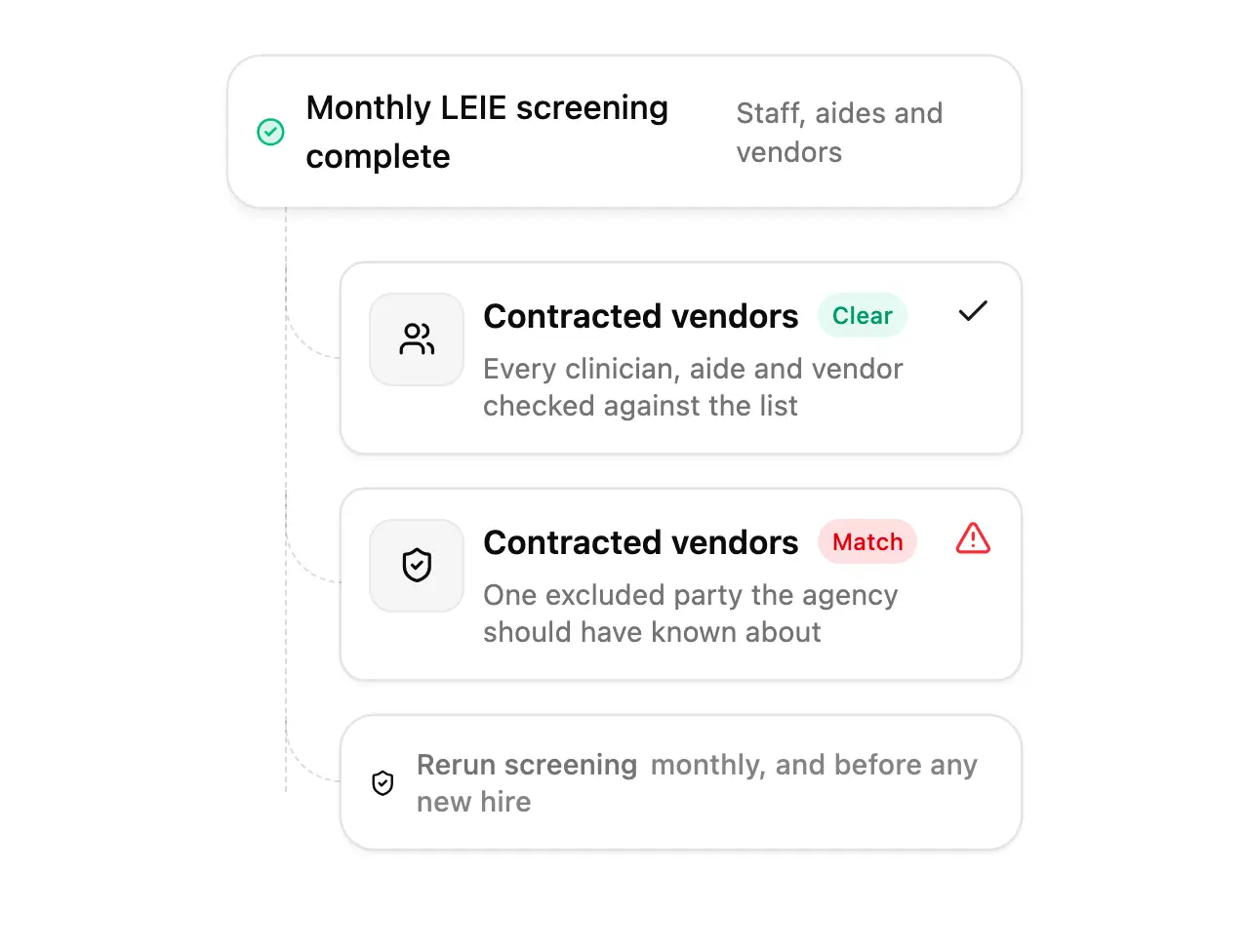
In a home health agency or hospice, the exposure reaches clinicians, aides, vendors and contractors furnishing services payable by a Federal health care program. Contracting with someone it should know is excluded may draw a civil monetary penalty5.
Sources
- eCFR (Office of the Federal Register), 42 CFR 1001.101, checked 2026-10-05
- Office of the Federal Register / eCFR, 42 CFR 455.436(c)(2), checked 2026-10-05
- eCFR (Office of the Federal Register), 42 CFR 1001.102(a), (d)(1)-(2), checked 2026-10-05
- Cornell Legal Information Institute (eCFR mirror), 42 CFR 1001.3001(a)(1); 42 CFR 1001.3002(d), checked 2026-10-05
- Office of the Federal Register / eCFR, 42 CFR 1003.200(b)(4), checked 2026-10-05
- Office of the Federal Register (eCFR), 42 CFR 1001.3002(a), paragraphs (a)(1)-(a)(3), checked 2026-10-05